Editor Notes: Flow and The Wild Robot
How The Wild Robot and Flow Present Opposing Views on Nature and Technology

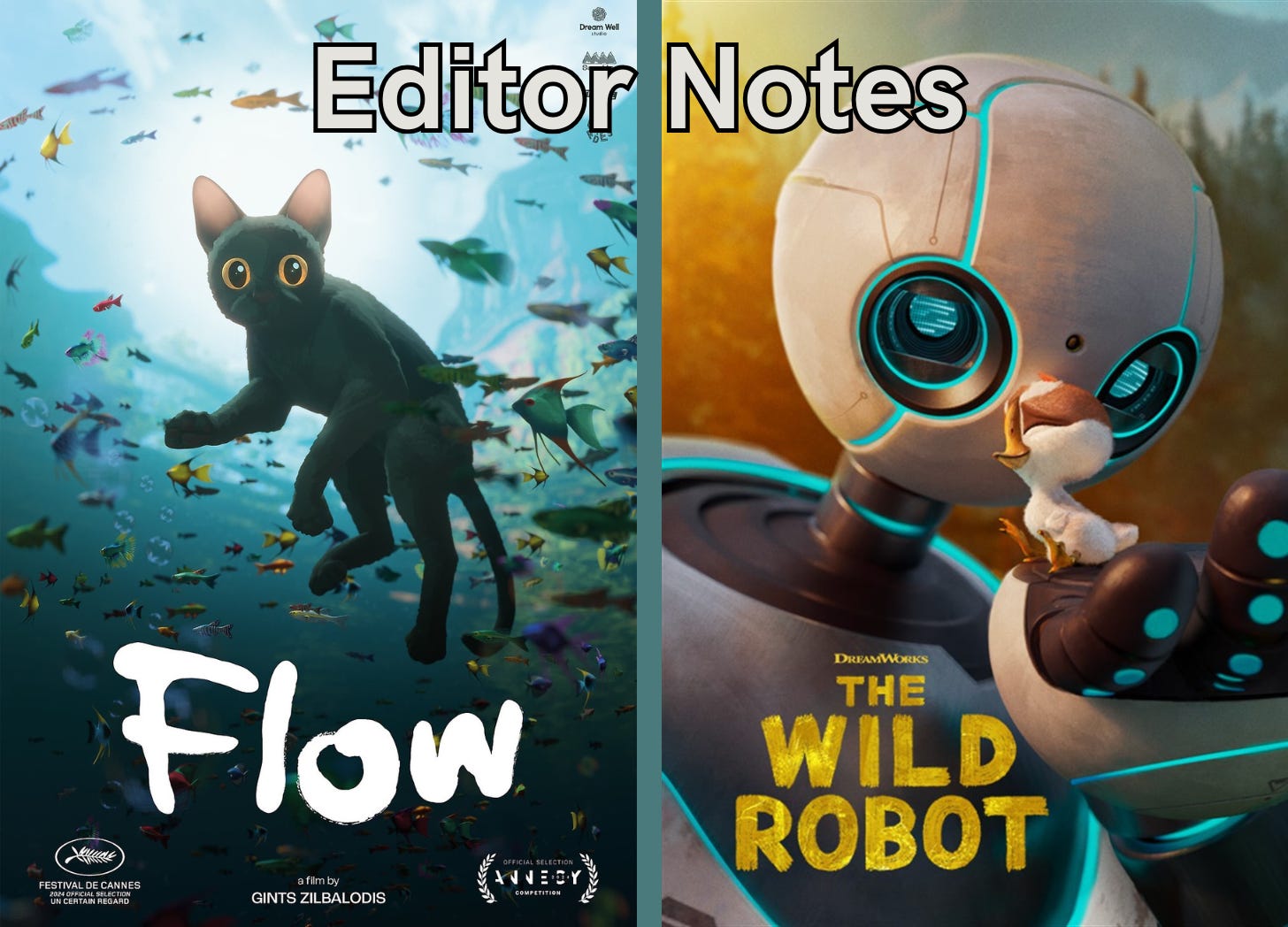
In a year where conversations about artificial intelligence and environmental crisis dominate public discourse (click here to help those affected by the L.A. wild fires), two 2024 animated features show different perspectives on humanity's relationship with the natural world. DreamWorks Animation's The Wild Robot and the indie feature Flow give us contrasting perspectives on humanity's relationship with the natural world, while both exploring themes of found family and adaptation.
The Wild Robot presents itself as a heartwarming tale of connection across the natural and artificial divide, following a sophisticated robot who becomes an unlikely parent to a goose after accidentally killing it’s family. Yep, he’s the one that orphaned him. Meanwhile, Flow takes a radically different approach, telling its story without dialogue, following a cat and its newfound animal companions as they navigate a flooded landscape. The contrast between these two approaches highlights much about how we view nature's ability to exist without us. Let’s get into it!
Check out my video review of The Wild Robot.
I’ll start with focusing on The Wild Robot. It’s central premise positions technology – specifically an advanced robot – as nature's savior. Especially during a crucial winter crisis, the robot becomes the animals' only hope (cue Princess Leia), implying that nature itself is insufficient without technological intervention. This message becomes particularly problematic when considering humanity's actual impact on wildlife, with studies showing a 60% decline in animal populations since the 1970s.
The Wild Robot, despite its villain being some evil tech company, ultimately suggests that nature needs saving through technological means. Also, the film ends with the robot's return to San Francisco and continued subservience to said evil corporation. At the end everything goes back to the status quo. But the robot does get the status of some folk hero to the animals. This presents a somewhat contradictory message about the relationship between technology and nature. Are we suppose to be mad at technology for what it’s done to the animals, or hopeful that some tech will come and help?
Flow inverts this dynamic, showing animals as capable agents of their own survival and making decisions based on natural instincts and needs.
Flow depicts animals adapting to environmental challenges through their innate capabilities and collective cooperation. The absence of human or technological assistance isn't presented as some handicap, but rather as the natural state of things. They are allowing the animals' own intelligence and adaptability to be what get’s them out of trouble.
This offers a more cohesive philosophical stance. By showing animals adapting to environmental challenges without external assistance, it affirms nature's inherent resilience and the importance of community within existing ecosystems. The film suggests that survival doesn't require technological intervention but rather depends on cooperation and adaptation within natural systems.
The Art of Storytelling
While both films tackle environmental themes, their storytelling approaches differ as well. The Wild Robot relies on traditional narrative structures that most animated fans and kids are used to, voice acting (including Matt Berry's scene-stealing performance as an outcast beaver), and overt themes. Despite my issues with this film, I do think it works well in it’s smaller moments, particularly in exploring themes of parental uncertainty and adopted family dynamics.
On the technical front, The Wild Robot employs an impressionistic realism style, with backgrounds reminiscent of watercolor paintings, setting itself apart from typical animated features. (Like seriously, why does the new Pixar look like a Pixar knockoff? Is it just me?) The score, however, while competent, fails to elevate the material in meaningful ways. It overall felt pretty generic. Not that I'm a musician and could do anything like that - I just didn't find it particularly unique or memorable. It was nominated for an Oscar this year, so please comment bellow to let me know what I’m missing.
Flow, on the other hand, takes the bold step of eliminating dialogue entirely, letting the animals' natural behaviors and interactions carry the story. This choice creates a more immersive and authentic portrayal of the natural world. The animals act as they would in nature, yet the film successfully builds emotional investment, proving that anthropomorphization isn't necessary for compelling storytelling. I mean Wall-E anyone?
This scene right here is just outstanding for it’s artistic vision and emotional stakes. Encapsulated what makes this film so great.
What's particularly fascinating about Flow is its attention to authentic detail. Sound designer Gurwal Coïc-Gallas used actual animal sounds for nearly every character. Even the music underwent an intimate process, with director Zilbalodis composing the whole score himself. And what he made was perfect for this film. It brought just enough without being distracting.
Flow as a whole represents something remarkable in modern animation - a vision brought to life by the creators hard work and dedication to his dream. Director Gints Zilbalodis first explored themes of animals and water in his widely acclaimed 2012 short film Aqua, about a cat overcoming its fear of the ocean - a premise that would later serve as the foundation for Flow.
It’s beautiful to see this original short of his and then see Flow to witness the evolution of concept and skill. This is all so inspiring!
In an industry dominated by major studios' marketing budgets and widespread distribution networks, Flow found its audience through film festivals and word-of-mouth acclaim. While operating under a different production model than DreamWorks' substantial Hollywood budget, Flow's clear artistic vision and dedication to authentic storytelling proved that compelling animation can emerge from any corner of the globe. The result is a testament to the democratization of animation tools (Flow was made on the open source software Blender) and the power of individual creativity in an industry often dominated by major studios. Flow’s Golden Globe win and Oscar nomination shows that at times a little film driven by passion can stand out. It’s such an amazing story! It’s going to be awesome to see him get the Oscar. IF he does of course.
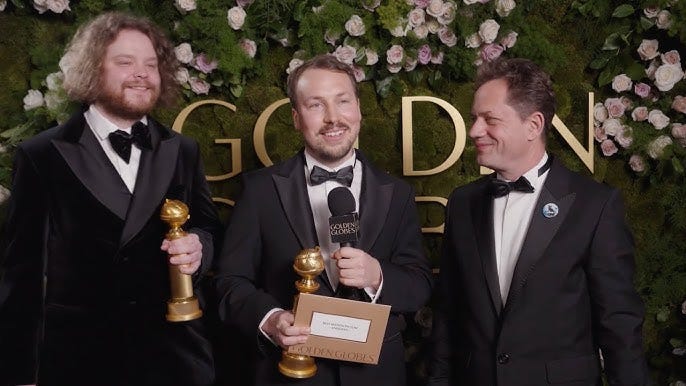
Perhaps most significantly, Flow's indie nature freed it from the common pressures that often affect studio productions like The Wild Robot. Without the need to appeal to focus groups, follow any algorithms or satisfy executives or shareholders, Flow could maintain it’s vision of a dialogue-free narrative that trusts its audience to connect with it’s characters. This creative freedom is in contrast to The Wild Robot's more conventional approach, where studio involvement may have contributed to its sometimes muddled messaging about technology and nature - an attempt to both critique and celebrate technological intervention that ultimately muddles its message.
While both films succeed in different ways – The Wild Robot, despite its charms, struggles with philosophical contradictions about technology's role in natural systems. Flow, through its more focused and naturalistic approach, offers a clearer and perhaps more honest perspective on environmental challenges and adaptation.
These contrasting approaches also raise important questions about how we present environmental messages to younger audiences. While The Wild Robot suggests technology might save us from environmental challenges, Flow implies that the solution might lie in better understanding and respecting natural systems that have evolved over millions of years. As we face increasing environmental challenges, these different perspectives offer valuable talking points about humanity's relationship with the natural world.