Editor Notes: Challengers
The Technical Stumbles and Triumphs of 'Challengers'

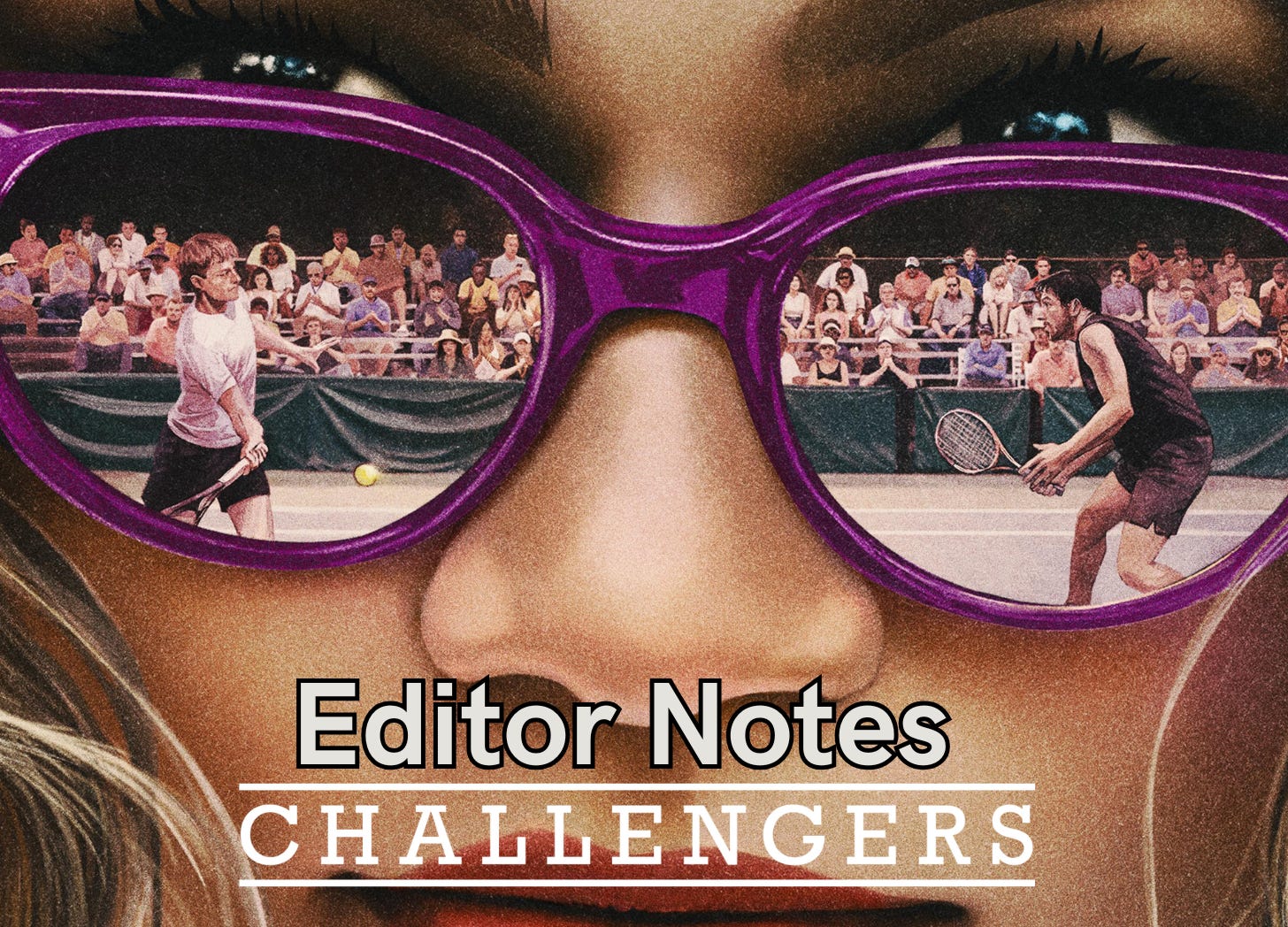
In tennis, mastering the fundamentals matters more than flashy plays. I learned this the hard way – when I was young , thanks to my mom, I loved tennis. She pushed me to play and even got me some coaches. I felt like I had a pretty solid return game, but could never get my service game right. To probably my mom's eternal disappointment, that weakness kept me from ever being truly competitive. Watching Luca Guadagnino's Challengers, I couldn't help but see parallels in its technical execution: brilliant in its complex moments, but sometimes stumbling on what should be easy points.
Here is my video breaking down the editorial decisions that I had a lot of questions about.
For those who don't know, here's the plot. Challengers follows Tashi Duncan (Zendaya), a tennis prodigy whose career-ending injury in college leads her to coaching. She takes Art (Mike Faist) from being above average to great – and marries him in the process. The story is anchored around one match where Art faces his old bestie and doubles partner Patrick (Josh O'Connor) as they both sit at a pivotal moment in their careers. Both men share history with Tashi dating back to their amateur days. Through flashbacks intercut during this final match, we see how their past tangles with their present. The match becomes this perfect metaphor for their relationship, complete with all the head games tennis is famous for.
When Challengers excels technically, it's masterful. The practice sessions showcase some awesome tennis cinematography choices, with POV shots that put you directly at the eye level of the net. The camera moves with each hit, capturing the disorientation of quick pivots and the intensity of watching the ball rocket toward you. These moments, paired with precise cutting on motion, create a visceral sense of being on the court.
The editing during these moments shows a deep understanding of tennis's natural cadence. They cut so well with the ball during rallies, then let the tension build between serves. The editing creates a beautiful rhythm - quick cuts during action balanced with lingering shots on faces as players reset, punctuated by well-timed slow motion. This rhythm mirrors actual tennis perfectly: explosion of movement, reset, explosion, reset. The Atlanta sequences are where I felt like everything starts to get into a good groove – camera work, sound design, and editing working perfectly. And the finale nearly redeems earlier missteps, building tension through precise editing rhythms that know exactly when to speed up and when to breathe.
But like my weak service game, the film's fundamentals sometimes falter. Multiple scenes cut while the camera's still moving, creating jarring transitions that pull you out of the moment.
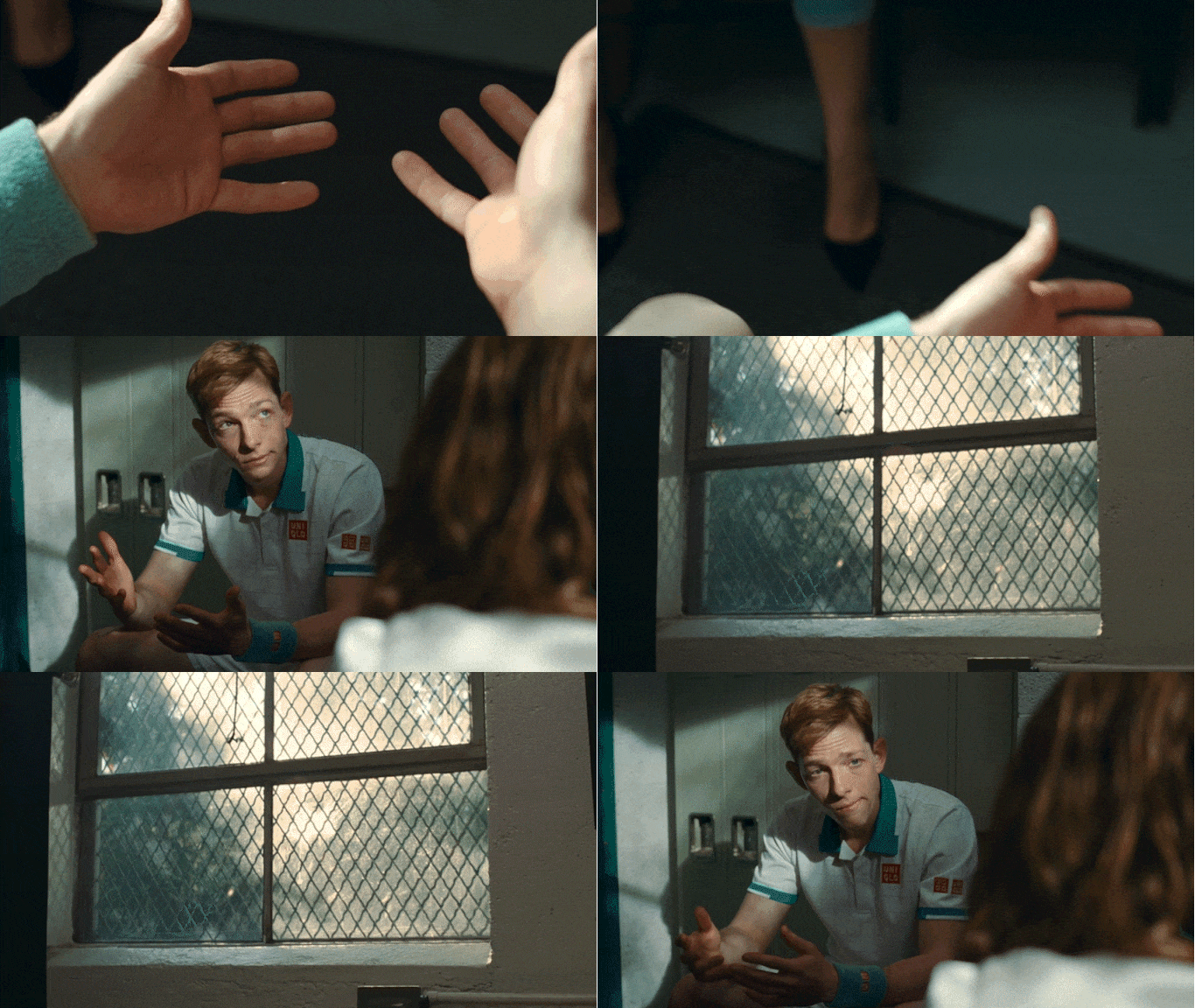
In my video above, I discuss this in detail, but these tilt and pan shots are problematic. It cuts from a moving shot to a static one without matching the eyeline. These mismatches can pull viewers out of the edit.
There's one particularly puzzling choice: during Tashi's career-ending revelation, we get this beautiful, emotional push-in shot – only to cut abruptly to a tight shot for a single second. As someone who's spent 20 years editing, this decision baffles me.

This jump cut in the middle of an emotional moment feels like a mistake. They don't use this technique anywhere else in the film, and it lacks any clear motivation.
Now, I want to acknowledge something here – no editing decision is made in a vacuum. Having spent countless hours in edit bays, I know the limitations editors face: coverage gaps, performance issues, and technical problems that only become apparent in the cutting room. Sometimes what looks like a mistake to us watching is actually the best solution to a problem we can't see. Maybe that one-second cut was covering a camera bump, or maybe it was the only usable piece of a crucial reaction. I'd love to know what battles were fought in that editing room, what compromises had to be made. Because a lot of times these decisions often come down to choosing the least problematic option rather than the ideal one. But, unfortunately, I can only judge what is in the final edit. Please comment if you can sell me on why making this cut here is a good decision.
I’d like to make a note about the music. Trent Reznor and Atticus Ross deliver a masterful hard electronic score that energizes the tennis matches brilliantly – their recent Golden Globe win comes as no surprise. What was a surprise was them not getting nominated for an Oscar over a movie like The Good Robot (Check out my review of The Good Robot). Yet there are moments where the music drowns out what should be quiet, emotional beats, as if the film doesn't trust its actors to carry these scenes.
Like a tennis match, technical filmmaking is about consistency. Challengers shows both the power of technical choices when they're perfectly executed and how even small missteps can throw off an otherwise great scene. The film excels at complex technical plays – those innovative sports sequences, dynamic camera work, and rhythmic match editing. Yet while it brilliantly captures the energy of tennis and the intensity of competition, it sometimes stumbles in quieter moments where simpler techniques would suffice. Just as my inability to master the serve held me back in tennis, the film's inconsistency with fundamental editing choices keeps it from achieving true greatness. It's a reminder that in both tennis and filmmaking, mastering the basics matters as much as pulling off spectacular shots.